
AI SEO
Every page built for Google and AI search.
A useful website needs to be discovered, understood, worth citing, and able to turn interest into customers. That work starts with page planning and continues through content, design, development, and updates after launch. Here is the framework, what we deliver, and where ongoing growth needs work beyond the build.
Read the thinking behind these choicesSearch demand
Start with the customers you want to reach.
Before deciding how many pages a website needs, identify the questions that bring the right customers to your business. Their language may describe a problem, a comparison, or a purchase decision rather than the name of your service.
For a website provider, that means looking beyond “web design” to questions such as cost, maintenance, ownership, and migration. A useful search opportunity connects a real customer need with something the business can credibly offer.
- Questions across the buying journey
- Collect the words customers use in enquiries, calls, and existing search reports. Separate learning, comparing, and buying questions; each needs a different answer and next step.
- Commercial relevance and useful differences
- Prioritize questions related to your service area, profitable work, and strengths. Review existing results for missing details that your experience, process, or evidence can supply.
- A search demand map
- Connect each priority question to its intent, proposed page, supporting evidence, and business goal. Agree the depth of keyword and competitor research before treating it as a project deliverable.
What “every page” means
We build and check the search foundations of the pages in the agreed website scope. Content planning uses your business knowledge and supplied facts. Extensive research, ongoing editorial production, and promotion need their own scope; indexing, rankings, and AI citations remain decisions made by external platforms.
Plan around the questions that matter to your customers and your business.
Page architecture
Give every important page a clear job.
A homepage cannot answer every service, pricing, and comparison question well. Assign each important intent to a suitable page, then connect those pages so a visitor can move from understanding the offer to evaluating it and making contact.
The page plan includes URLs, navigation, breadcrumbs where useful, and related links. Distinct pages should offer distinct value rather than repeat the same answer for slightly different keywords.
Scroll horizontally to see all columns.
| Page | Purpose | Questions to answer |
|---|---|---|
| Home | Introduce the business | Who are you, who do you serve, and why choose you? |
| Service | Explain a specific offer | What is included, for whom, and how is it delivered? |
| Pricing | Clarify the investment | What does it cost, under which conditions, and what costs extra? |
| Case study | Provide evidence | What problem was solved, what changed, and what supports the result? |
| Guide or comparison | Help a customer decide | How do the options differ, and what are the tradeoffs? |
| About and contact | Establish identity and trust | Who is responsible, and how can a customer reach you? |
- An intent-to-page plan
- Give each proposed page a primary audience, core question, and next step. Combine overlapping pages where appropriate; retain separate pages when their purpose and substance justify them.
- A connected website
- Use descriptive navigation and real HTML links. Link a service to relevant proof, a guide to the service it explains, and pricing to the next step in the sales process.
Deliverable: a page map with a purpose, URL, and relevant links for each page.
Content & evidence
Write answers that can stand on their own.
A page needs useful information before metadata can describe it. Answer the main question directly, then explain the scope, conditions, process, and limitations. Specific answers help customers evaluate the business and give search systems something meaningful to reference.
“Exceptional digital experiences” says little about an offer. A clear explanation of which maintenance is included, how support works, and which requests cost extra gives the reader information they can use.
- A brief for each page
- Specify the core question, audience, answer, supporting facts, and CTA. Use explicit service or product names so a key paragraph still makes sense when read outside the rest of the page.
- Evidence behind the claim
- Use genuine examples, approved case studies, data with context, and relevant sources. Identify the responsible author or reviewer and include meaningful dates and applicable conditions where needed.
- A format suited to the answer
- Use tables for comparisons, numbered steps for a process, and FAQs for real customer questions. Clear structure and accurate updates can make a source easier to reference; they do not guarantee an AI citation.
- Expertise stays with the expert
- You or an industry professional supply and approve the domain knowledge. We help organize and present it. AI-assisted drafts still need a human to check facts, permissions, and whether the answer is useful.
Deliverable: a content brief and a record of the facts and evidence needed for each agreed page.
Design & experience
Make the answer easy to reach and read.
Search requirements belong in the design system. The visual layout should support the page's meaning: a logical heading hierarchy, readable text, accessible navigation, and a next step suited to the visitor's question.
Core content should be present without waiting for an animation, a click, or a login to load it. The mobile page needs the same useful information, with a layout that keeps reading and taking action comfortable.

Prepared HTML supports early content delivery. Sized images and deliberate font loading reduce visual instability. Focused scripts limit interaction work. Browser checks and available field measurements inform subsequent improvements.
- Text, headings, and links
- Keep important copy as real text. Set HTML heading levels according to the content hierarchy, independently of their visual size. Use real links for navigation and related information, and suitable image descriptions.
- Components with content rules
- A case-study component should require the context, approach, result, and evidence as well as visual styling. A pricing component should make inclusions, conditions, and extra costs clear.
- Performance and accessible interaction
- Budget images, video, fonts, and scripts; reserve image space to reduce layout shifts. Check keyboard focus, forms, reduced-motion preferences, HTTPS, and overlays that could interrupt reading.
- A useful next step
- A pricing page can lead to a consultation; a guide can link to the relevant service. Check loading, layout stability, and interaction in the browser, then use real-user Core Web Vitals when data is available.
After the visual impact, what can visitors see?
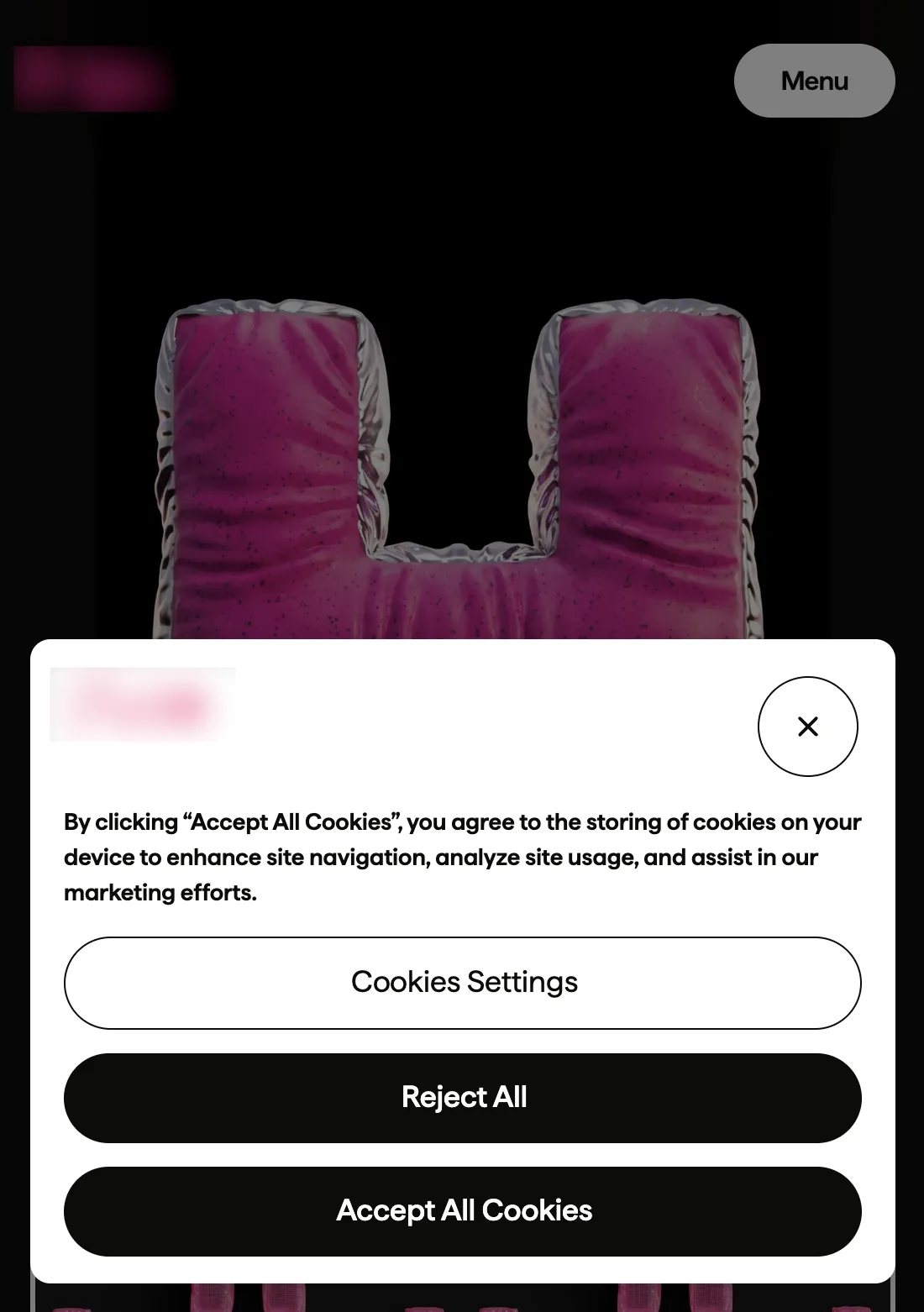
This mobile screenshot comes from the website of a well-known, industry-leading web design and development agency. The brand visual is striking, but a cookie dialog covers much of the first screen, and visitors need to deal with it before they can continue browsing.
- Performance
- 34 / 100
- Largest Contentful Paint
- 7.7 s
- Total Blocking Time
- 1,390 ms
The accompanying PageSpeed screenshot shows a Performance score of 34, a Largest Contentful Paint of 7.7 seconds, and Total Blocking Time of 1,390 milliseconds. For us, making information visible and the page responsive are design decisions, too.
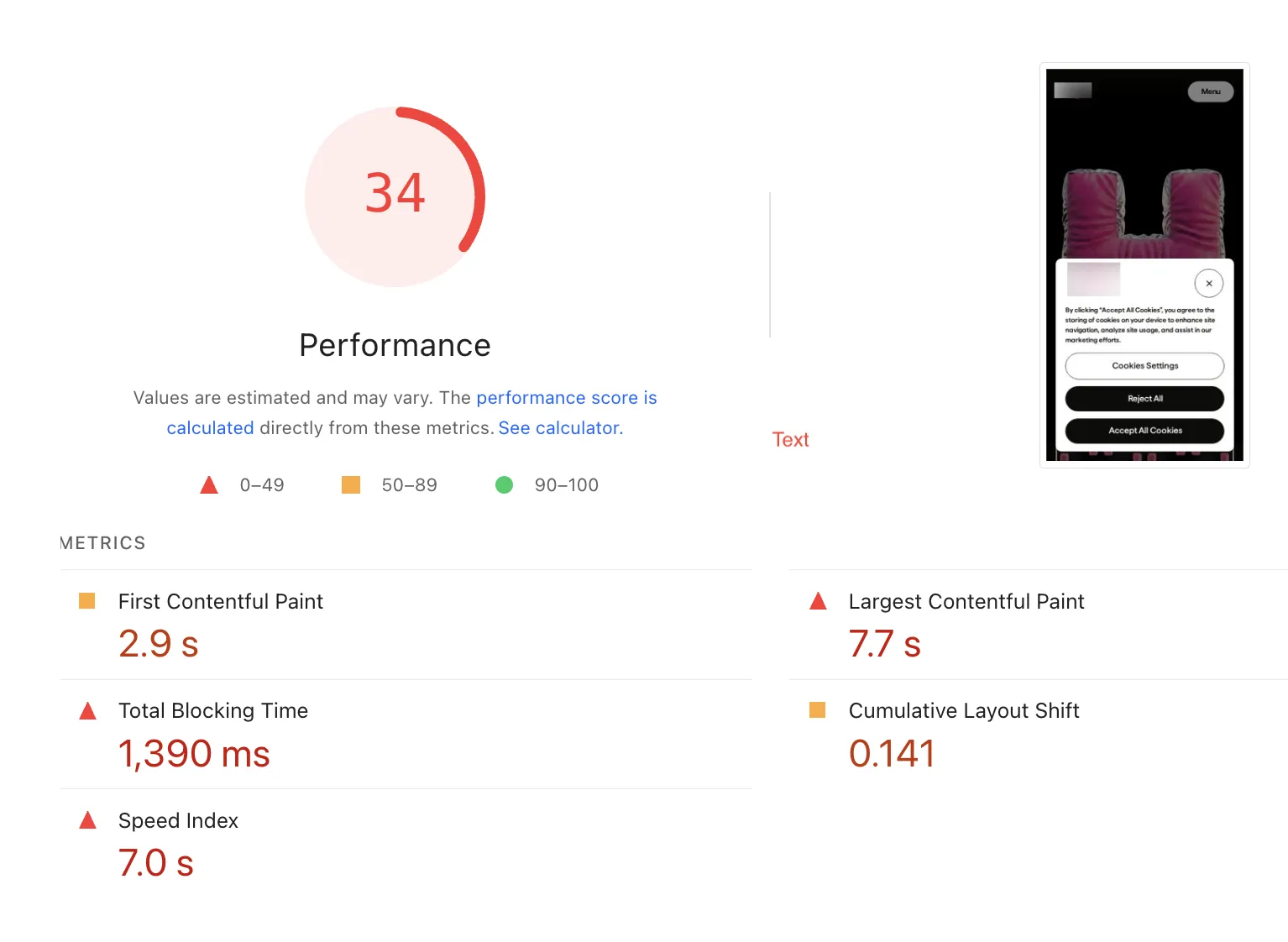
Source: supplied mobile page and PageSpeed screenshots, with the brand logo blurred. Scores reflect the single test shown; the other three category scores are not visible in the screenshot.
Good page experience supports visitors and search; it cannot guarantee a ranking.
Technical & AI access
Deliver readable pages with deliberate access controls.
For public React marketing pages, we prefer static generation or server rendering so the first HTML response contains the main content and links. This reduces dependence on a crawler executing JavaScript. We inspect the response a visitor or crawler actually receives.
Each page needs appropriate discovery, indexing, and metadata rules. “Every page” does not mean every URL should be indexed: login pages, internal search results, duplicate filters, and private content need deliberate policies.

Internal links and sitemaps help discover a URL. Hosting access, readable HTML, and indexing controls make evaluation possible. The search platform then decides whether to index and display it.

A page's purpose connects its title and description, visible headings and content, canonical and language URLs, relevant structured data, and next-step links.

Google search access uses Googlebot rules, including its AI search features. ChatGPT search access uses OAI-SearchBot. GPTBot training preferences are controlled independently. Search permission does not imply training permission.
- Page configuration
- Check titles, descriptions, canonical URLs, correct response codes, and hreflang for language versions. Metadata should match the visible page. A description can inform a snippet; Google may choose other text.
- Discovery, duplicates, and migrations
- Review robots.txt, XML sitemaps, index and snippet controls, parameters, redirects, and 404s. Map old URLs to relevant new destinations during a migration. A sitemap helps discovery; noindex is not protection for private information.
- Structured data that matches the page
- Use appropriate types for accurate, visible business and page information. Validate supported markup and required fields. Structured data helps describe content without guaranteeing a rich result.
- Access through the hosting layer
- Check CDN, firewall, rate limits, and bot rules for unintended blocks. Review documented crawler identities and IP ranges where applicable; a robots.txt permission alone does not establish that the page is reachable.
Google AI search and ChatGPT access
Google says AI Overviews and AI Mode use established SEO foundations, with no special AI schema or text file required. A supporting page must be indexed and eligible for a search snippet. For ChatGPT, OAI-SearchBot controls search crawling; GPTBot controls crawling that may be used for training. The choices are independent: allowing training is not required for ChatGPT search.
Deliverable: page-level configuration and checks of the rendered HTML and crawler access.
Identity & reputation
Make the business and its experience verifiable.
Explain who the business is, what it offers, and who stands behind the work. Consistent names, service descriptions, contact details, and genuine examples help a reader check whether the business is a good fit.
Reputation also develops outside the website. Real customer reviews, partner profiles, relevant directories, and editorial mentions can provide independent evidence. Confident copy on the website cannot create that evidence by itself.
- On-site identity
- Publish accurate business information, a real team or responsible contact, approved testimonials, and case studies with context. Keep those facts consistent across pages and structured data.
- Off-site responsibility
- You or your marketing partner develop genuine reviews and relevant external relationships. Eligible local businesses should maintain their business profiles. Review requests, outreach, PR, and link campaigns are outside the website build and Care scope.
A website can present your credibility; real experience and independent evidence supply it.
CMS & publishing
Keep the standards in place as the site grows.
The next page should benefit from the same structure as the first. Where a CMS is part of the agreed project, define fields and publishing checks around each content type so important information is not left to an empty text box.
Automate predictable checks and generated metadata. Keep factual accuracy and the decision to publish with a human reviewer; an AI draft should not become a live article without review.
- Fields that guide the author
- Capture the core question, title, summary, body structure, relevant service or case study, and internal links. Include author, reviewer, meaningful update date, and image descriptions where appropriate.
- Rules that protect the output
- Define canonical and index policies, schema generation, required fields, and preview checks for each page type. Validate those rules against the published HTML, not only the CMS form.
- An accountable publishing process
- Agree who supplies facts, approves content, publishes changes, and revisits outdated information. CMS integration and additional content types are scoped add-ons; ongoing editorial production requires separate planning.
Deliverable when CMS is in scope: content fields, publishing rules, and a clear review workflow.
Validation & measurement
Track technical health, visibility, and business value.
At launch, check that intended public pages can be fetched, the main content is present, and indexing rules are correct. After launch, combine search reports with enquiries and sales information to see whether the website reaches suitable customers.
AI observations need a repeatable method. Keep the question set, language, region, and search mode consistent; record dates, cited pages, and description accuracy. Sample repeatedly over time. A single mention or missing recommendation is weak evidence of progress.
Scroll horizontally to see all columns.
| Layer | What to check | What it tells you |
|---|---|---|
| Technical health | Crawler access, complete content, response codes, index and snippet rules | Whether the page can be evaluated as intended |
| Google visibility | Indexing, queries, impressions, clicks, and landing pages in Search Console | Which searches reach the site and how that changes |
| AI visibility | Mentions, citations, source URLs, description accuracy, and available referrals | Where observed answers use the business or its content |
| Business results | Qualified enquiries, bookings, sales, and acquisition cost when measurable | Whether search interest contributes to customers |

Primary documentation and observed results lead to a hypothesis, a controlled change, review of the evidence, and a decision to adopt, revise, or discard it. Findings inform the next research cycle.
- Use reports within their limits
- Google includes AI feature traffic in Search Console's overall Web reporting. Bing Webmaster Tools provides AI citation reporting across supported Microsoft and select partner experiences; it does not cover every AI platform or prove ranking or authority.
- Record changes and compare trends
- Keep a baseline, the hypothesis, what changed, and the observations that follow. Check for misleading citations as well as missing ones. Use available field performance data alongside browser and lab checks.
- Connect visibility to the business
- Agree what qualifies as a useful enquiry and how bookings or sales can be attributed. Where analytics and account access are available, use those signals to prioritize the next improvement. Dedicated AI monitoring and reporting need an agreed scope.
Deliverable: launch checks, then an agreed measurement plan with the tools and access it needs.
Delivery & scope
A search foundation at launch. Clear responsibilities after it.
The framework above guides the website project; the proposal defines which pages, research, integrations, and reporting are included. Our baseline promise is “Every page built for Google and AI search.” It describes the work we can inspect and deliver.
Ongoing exposure depends on useful content, reputation, competition, and feedback over time. SiteMonk Care maintains the foundation and applies relevant SEO and AI search improvements within the agreed service scope. Content campaigns and external promotion require their own owners and resources.
Scroll horizontally to see all columns.
| Work | Responsibility | Scope |
|---|---|---|
| Website build | SiteMonk, with your input and approval | Agreed page structure, presentation of supplied content, technical setup, and launch checks |
| SiteMonk Care | SiteMonk | Maintain the foundation and make relevant technical and structural improvements; larger additions are scoped separately |
| Expert content and reputation | You or your industry and marketing partners | Accurate facts, expert review, fresh evidence, editorial work, genuine reviews, and external relationships |
| Additional project work | Owner and deliverables agreed in advance | Extensive keyword research, CMS integration, new pages, and dedicated monitoring or reporting |
-
Research the need
Identify the audience, questions, business goals, and the research included in the project.
-
Map the pages
Assign intent, purpose, URLs, and relevant internal links.
-
Prepare content briefs
Define answers, gather supporting facts, and agree who approves them.
-
Design pages and components
Build content rules, reading structure, accessible interaction, and suitable next steps into the design.
-
Implement the website
Deliver readable HTML, page configuration, crawler policies, and publishing rules.
-
Validate the launch
Check delivered pages, links, index controls, mobile usability, and measurement setup.
-
Monitor and update
Maintain the foundation, review available evidence, and agree the next content or technical improvement.
Commit to the work and its quality. Use evidence to improve the results over time.